Ingredients
Method
- In a small mixing bowl mix the yeast, flour and water until combined. Cover tightly with plastic wrap and preferably let sit overnight in the fridge to allow the yeast to slowly work its magic. Remove from the fridge and allow the starter to come to room temperature. If there are time constraints, make the starter with warmed water (110 degrees - no, I do not really stick a thermometer in it - think bath water for a baby) and cover, letting it rise for at least 30 minutes.
- Mix the starches, Metamucil, xanthan gum, potato flakes and salt in bowl of standing mixer fitted with the paddle attachment. Mix rice milk, butter, honey, and starter together, preferably in a large liquid measuring cup. Turn machine to low and slowly add liquid. Mix for one minute. It will be the consistency of a very thick but smooth cake batter.
- Cover the mixer bowl with saran wrap and let rest for 5 to 10 minutes. The purpose here is not for the dough to rise, but to allow the liquids to be fully absorbed by the starches and make the dough more manageable to handle/shape.
- Again with the paddle attachment, mix on low to medium setting (4 on Kitchen Aid) for 2 to 3 minutes, pausing the mixing halfway to scrape the dough off the sides of the bowl. You are incorporating air into the dough which the gas from the yeast will expand, allowing for a lovely rise. As the dough mixes, it will get a little stretchy, but still stick to the sides of the bowl. The dough should be nice and smooth.
- Add a little wheat starch to your work area. With a rubber spatula, gather the dough from the mixer bowl and place on top of the starched area. Gently knead the dough a few turns, incorporating the remaining starch. You should have a nice smooth but somewhat sticky dough. Gently shape/roll the dough into a cylinder shape and place in a greased 8-by-4 inch loaf pan (which is slightly smaller than many bread pans). It should be touching all four sides of the pan.
- Cover with lightly greased plastic wrap and a damp kitchen towel; set aside in warm spot* until dough almost doubles in size, about 60 minutes (but the time range can be from 45 minutes to 90 so keep an eye on it).
- Meanwhile, place an empty loaf pan (or oven proof skillet) in the oven. Heat the oven to 400 degrees. Bring 2 cups water to boil.
- Remove plastic wrap from loaf pan. Place pan in oven, immediately (and carefully) pouring heated water into the empty loaf pan; close oven door. The reason for this is that when dough first goes into a hot oven, there is a rapid rise in volume called oven spring. If there is moisture or steam (which is what you are creating with the hot pan and water), the starches do not form a crust as quickly, allowing for a greater “spring.”
- Decrease the oven to 375 degrees.
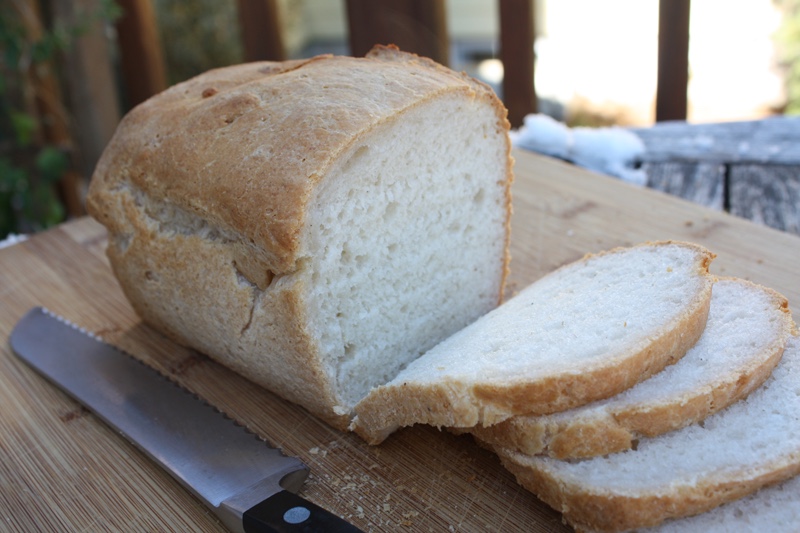
- After 30 minutes, brush the loaf with the remaining melted butter to help the browning. Bake for an additional 15 minutes. Remove loaf from the pan and place directly on the center of the rack (or pizza stone if it is in the oven). Continue baking until the loaf sounds hollow when rapt lightly with your knuckles on the bottom, about 15 minutes.
- Remove bread from oven, place on a wire rack, and cool to room temperature. Slice and serve.
Notes
TIP: * Good places to let the bread rise (1) Warm a cup of water on high for 1 minute in a microwave to create a warm moist environment. Place the covered loaf in the microwave (with cup of hot water still inside) and close the door. (2) Preheat oven to 200 degrees for 2 minutes. Turn oven off, place covered loaf inside. (In both cases no peeking before 30 minutes or it will cause a rapid cooling of the environment.) If the nail biting suspense is too much for you and you need to see what is happening, you can also boil a small pot of water, turn it off and place the pan on top. You might need to reheat the water once during the rising process (make sure you remove the dough when you are doing this!)
Reader Q&A:
Q: Do I need to use rice milk or can I use flax milk or So Delicious creamer instead? Thanks! A: I have only used rice milk because that is what we tend to have. I think flax milk would be fine. The so delicious creamer -- if it is a neutral flavor and not too creamy, it should be fine (if creamy, dilute with 1/3 water).
Brenda
Q: I've made this several times, but I had access to a stand mixer before and I do not now. I think there used to be tips for making this recipe with a hand mixer, but I'm not seeing them now. Any advice for getting the best results with a hand mixer would be much appreciated! Thanks! A: Hi Stephanie,
Use the whisk attachment and mix it on medium/high.
Brenda
Q: What does this mean?
Continue baking until the loaf sounds hollow when rapt lightly with your knuckles on the bottom, about 15
minutes. Rapt lightly with knuckles? A: Tap/knock on it lightly with your knuckles.
Q: Can this recipe be used/ or has anybody made in a bread maker? A: Hi Julia,
I have never had great success in a bread maker. The bread comes out much more dense. Others have been happy with the results (but the photos they send are denser loaves).
Brenda
Q: Brenda--do you recommending freezing the bread?
Dianne Muller A: Absolutely. I keep out what my daughter will eat for two days and freeze the rest (sliced).
Q: Brenda--can the baked bread be frozen for future use? Dianne A: Absolutely. I slice and freeze all of the time. For a sandwich, I like to place two frozen pieces together into one slot in the toaster. That way the outside has a little crunch, but the bread is still a little soft.
Q: I know you answered saying it usually more dense but, I was wondering, can you substitute cake flour for the AP flour would that help with density I know it does for non low protein baked goods but not sure here also, if making in a bread maker I add all the ingredients listed starter and all in bread maker and then follow bread maker instructions correct or do I leave out some? A: Substituting cake flour with AP flour in the starter will not help with the density of the bread should you choose to use a bread machine (which as you know I do not recommend). Reducing the metamucil to 18 gm (1 1/2 T) helped a little, but the loaf was significantly more dense than when made in a pan.
Q: Can I sub maple syrup for the honey? Or something else? I have a 9 month old PKUer, and honey should be avoided until after age 1. Thank you! A: Sugar or maple syrup will be fine.
Q: Hello- I have never tried this recipe before and am now trying it during quarantine for the corona virus. It's impossible to find yeast anywhere! Is there any substitute I could use? I googled it and found baking soda/lemon juice substitute- would that work here? And if yes, do I still have to let the starter sit in the fridge or just use it as is? Thanks so much. A: No that won't work for this recipe. I know a good few people are struggling with this. I am working on a non-yeasted bread that I hope to get up on the site in the next few days. Are you on our facebook group? If so, I will post there when it is up on the site.
Q: Hi Brenda, I’ve been making regular sourdough for my non-pku-ers and was wondering if I could use my sourdough starter in place of your starter? If so, how much starter should I use?
Best,
Meg A: I wish I knew the answer to this Meg. Planning on playing with sourdough starter in the near future in case this yeast shortage continues. I will put updates on our facebook page if I get anywhere on this baking adventure!
Q: Anything I can substitute for the tapioca starch? A: I have used cassava flour in a pinch, but the loaf was more dense. If you absolutely cannot find it, try all wheat starch or corn starch -- but under normal circumstances it is worth getting.
Q: Hello, can anyone help...I've tried this bread a few times now and it does not rise much stays heavy and doughy?? What am I doing wrong?
Please help Thanks and is there a bread machine dough recipe anywhere since Welplan left us, so sad.
Thank you A: Just finished making a video of the bread -- should be up on site today. Hopefully that will help!
Q: Hi does gluten free dried yeast work? A: yes
Q: Where do you purchase wheat starch? I'm unable to find it anywhere. Or is there another substitute? A: If you look in the In Our Pantry section, there is a list of places. -- Brenda
Q: I’m having trouble buying Metamucil and the generic brand makes the dough pinkish. Is there a better substitute? A: You can use pure psyllium husk, just add 1/2 the amount. You can post question on our Facebook page -- I bet some members know which brands of psyllium husk fiber do not have that hue.
Q: Can I use a 1 lb Pullman loaf pan? If so should I make 1.5 the recipe? A: Yes to both questions.
Q: Hello Brenda, I have made your bread a few times, it is delicious. But I always have the problem that it is way too sticky! It never turns into that nice dough like in the video. Instead I always have to scrape it off my fingers. And yes, I do leave it to rest for 20 to 30 min for everything to absorb.
I have to use the pure physillum husk because we can't get metamucill here. I use half the amount, but maybe I should use more? Or leave it to rest longer? Would be grateful for any advice, as I also have this problem with things like pizza dough. Thank you. A: Where do you live? Any chance higher altitude is playing a role? I would add 30 gm less of rice milk and see if that helps. If that does not work, take some photos if you can and post on Cook for Love's FB group and I can try to problem solve further. -- Brenda
Q: Can you use flax milk instead of Rice milk? A: yes
Q: I was so impressed with the fluffiness of the Stuffing Bread that I made at Thanksgiving. I was wondering if I substituted the potato flakes with the real mashed potato and replaced part of the rice milk with the potato water if that would make the bread even fluffier.... And what that might do to the Phe. I so appreciate all of your recipes. A: I do this all of the time, but did not want to make it an extra step in the already complicated process! 60 gm of boiled potato in place of the dried potato flakes adds 20 mg phe, but using 120 gm rice milk and 120 potato water gives you back 13 mg, so only 7 mg for entire loaf. (You need to reduce the total liquids by 30 gm since there is so much moisture in the boiled potato).
Q: For the butter. Salted or unsalted? A: Either is fine
Q: My granddaughter, like most of my family, is sensitive to too much gluten. I have been using gluten free measure for measure flour for my non-PKU baking. Do you think it would work as a substitute for the regular flour in the starter in this recipe? A: I would think so
Q: Do I need to use rice milk or can I use flax milk or So Delicious creamer instead? Thanks! A: I have only used rice milk because that is what we tend to have. I think flax milk would be fine. The so delicious creamer -- if it is a neutral flavor and not too creamy, it should be fine (if creamy, dilute with 1/3 water).
Brenda
Q: I've made this several times, but I had access to a stand mixer before and I do not now. I think there used to be tips for making this recipe with a hand mixer, but I'm not seeing them now. Any advice for getting the best results with a hand mixer would be much appreciated! Thanks! A: Hi Stephanie,
Use the whisk attachment and mix it on medium/high.
Brenda
Q: What does this mean?
Continue baking until the loaf sounds hollow when rapt lightly with your knuckles on the bottom, about 15
minutes. Rapt lightly with knuckles? A: Tap/knock on it lightly with your knuckles.
Q: Can this recipe be used/ or has anybody made in a bread maker? A: Hi Julia,
I have never had great success in a bread maker. The bread comes out much more dense. Others have been happy with the results (but the photos they send are denser loaves).
Brenda
Q: Brenda--do you recommending freezing the bread?
Dianne Muller A: Absolutely. I keep out what my daughter will eat for two days and freeze the rest (sliced).
Q: Brenda--can the baked bread be frozen for future use? Dianne A: Absolutely. I slice and freeze all of the time. For a sandwich, I like to place two frozen pieces together into one slot in the toaster. That way the outside has a little crunch, but the bread is still a little soft.
Q: I know you answered saying it usually more dense but, I was wondering, can you substitute cake flour for the AP flour would that help with density I know it does for non low protein baked goods but not sure here also, if making in a bread maker I add all the ingredients listed starter and all in bread maker and then follow bread maker instructions correct or do I leave out some? A: Substituting cake flour with AP flour in the starter will not help with the density of the bread should you choose to use a bread machine (which as you know I do not recommend). Reducing the metamucil to 18 gm (1 1/2 T) helped a little, but the loaf was significantly more dense than when made in a pan.
Q: Can I sub maple syrup for the honey? Or something else? I have a 9 month old PKUer, and honey should be avoided until after age 1. Thank you! A: Sugar or maple syrup will be fine.
Q: Hello- I have never tried this recipe before and am now trying it during quarantine for the corona virus. It's impossible to find yeast anywhere! Is there any substitute I could use? I googled it and found baking soda/lemon juice substitute- would that work here? And if yes, do I still have to let the starter sit in the fridge or just use it as is? Thanks so much. A: No that won't work for this recipe. I know a good few people are struggling with this. I am working on a non-yeasted bread that I hope to get up on the site in the next few days. Are you on our facebook group? If so, I will post there when it is up on the site.
Q: Hi Brenda, I’ve been making regular sourdough for my non-pku-ers and was wondering if I could use my sourdough starter in place of your starter? If so, how much starter should I use?
Best,
Meg A: I wish I knew the answer to this Meg. Planning on playing with sourdough starter in the near future in case this yeast shortage continues. I will put updates on our facebook page if I get anywhere on this baking adventure!
Q: Anything I can substitute for the tapioca starch? A: I have used cassava flour in a pinch, but the loaf was more dense. If you absolutely cannot find it, try all wheat starch or corn starch -- but under normal circumstances it is worth getting.
Q: Hello, can anyone help...I've tried this bread a few times now and it does not rise much stays heavy and doughy?? What am I doing wrong?
Please help Thanks and is there a bread machine dough recipe anywhere since Welplan left us, so sad.
Thank you A: Just finished making a video of the bread -- should be up on site today. Hopefully that will help!
Q: Hi does gluten free dried yeast work? A: yes
Q: Where do you purchase wheat starch? I'm unable to find it anywhere. Or is there another substitute? A: If you look in the In Our Pantry section, there is a list of places. -- Brenda
Q: I’m having trouble buying Metamucil and the generic brand makes the dough pinkish. Is there a better substitute? A: You can use pure psyllium husk, just add 1/2 the amount. You can post question on our Facebook page -- I bet some members know which brands of psyllium husk fiber do not have that hue.
Q: Can I use a 1 lb Pullman loaf pan? If so should I make 1.5 the recipe? A: Yes to both questions.
Q: Hello Brenda, I have made your bread a few times, it is delicious. But I always have the problem that it is way too sticky! It never turns into that nice dough like in the video. Instead I always have to scrape it off my fingers. And yes, I do leave it to rest for 20 to 30 min for everything to absorb.
I have to use the pure physillum husk because we can't get metamucill here. I use half the amount, but maybe I should use more? Or leave it to rest longer? Would be grateful for any advice, as I also have this problem with things like pizza dough. Thank you. A: Where do you live? Any chance higher altitude is playing a role? I would add 30 gm less of rice milk and see if that helps. If that does not work, take some photos if you can and post on Cook for Love's FB group and I can try to problem solve further. -- Brenda
Q: Can you use flax milk instead of Rice milk? A: yes
Q: I was so impressed with the fluffiness of the Stuffing Bread that I made at Thanksgiving. I was wondering if I substituted the potato flakes with the real mashed potato and replaced part of the rice milk with the potato water if that would make the bread even fluffier.... And what that might do to the Phe. I so appreciate all of your recipes. A: I do this all of the time, but did not want to make it an extra step in the already complicated process! 60 gm of boiled potato in place of the dried potato flakes adds 20 mg phe, but using 120 gm rice milk and 120 potato water gives you back 13 mg, so only 7 mg for entire loaf. (You need to reduce the total liquids by 30 gm since there is so much moisture in the boiled potato).
Q: For the butter. Salted or unsalted? A: Either is fine
Q: My granddaughter, like most of my family, is sensitive to too much gluten. I have been using gluten free measure for measure flour for my non-PKU baking. Do you think it would work as a substitute for the regular flour in the starter in this recipe? A: I would think so
