
Oh my nemesis — I have been working on you for ages. Special shout out to the amazing Chris Kulusic of Varietal Bread Company who gave me a private demo to show me how he makes his incredible sourdough. His tips helped make my dream of a low pro sourdough a reality.
Before you start, please see this article to understand the complexity of evaluating phe & protein in sourdough starter.
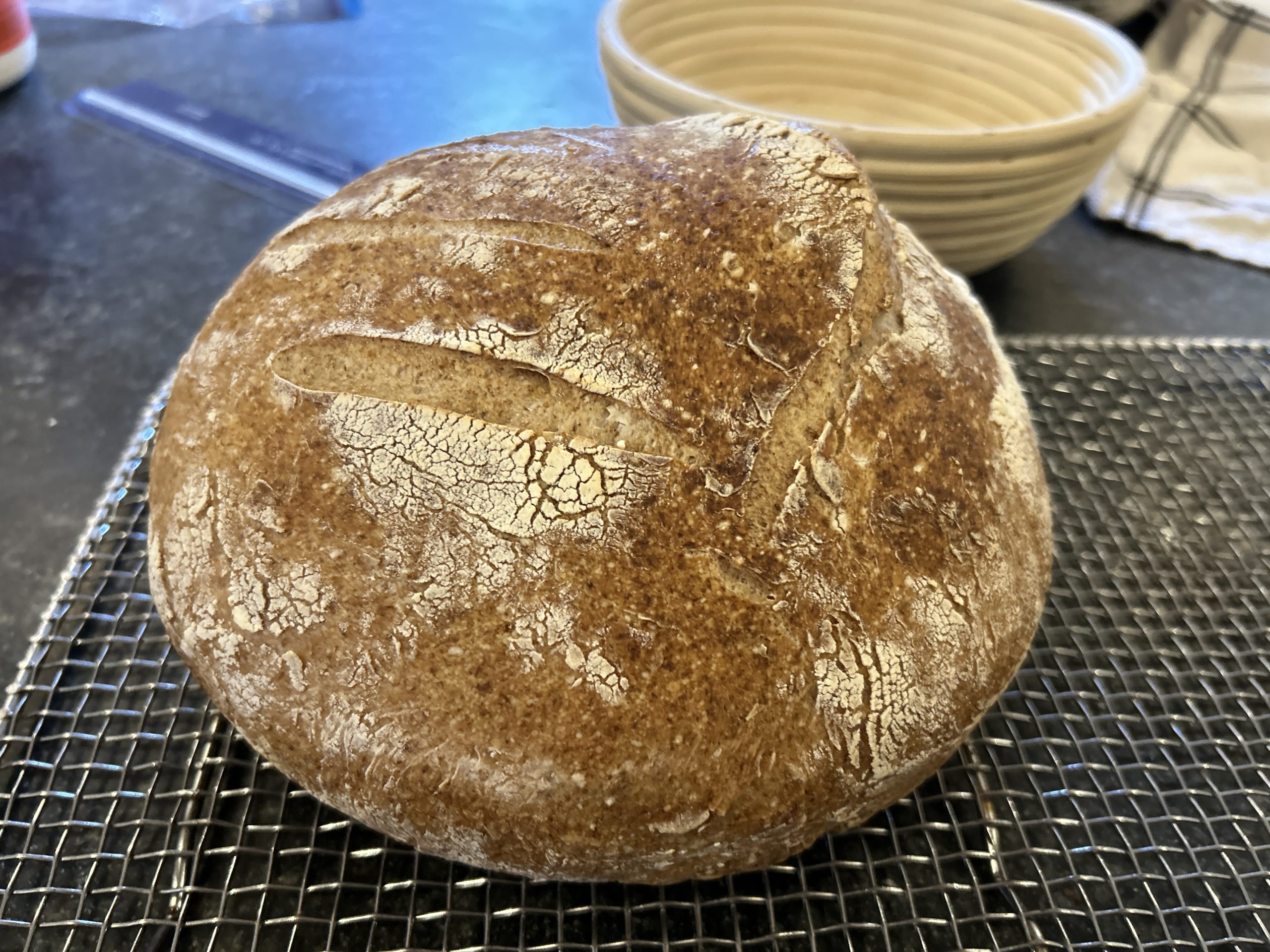
Sourdough Bread
Oh my nemesis — I have been working on you for ages. Special shout out to the amazing Chris Kulusic of Varietal Bread Company who gave me a private demo to show me how he makes his incredible sourdough. His tips helped make my dream of a low pro sourdough a reality.
Before you start, please see this article to understand the complexity of evaluating phe & protein in sourdough starter.
Ingredients
Method
- In a small mixing bowl combine the ripe sourdough starter with the flour and water. Let it sit until it has doubled in size (about 4 hours). You can let it go longer if you want a more intense sour dough taste (up to overnight). Once you are ready to use the levain, add in the half teaspoon of commercial yeast.
- After the levain is ready to go, combine the Metamucil (or 4 Tablespoons — 24 gm– whole psyllium husk) with the cup of warm water. Stir and let it sit and gel up. Set aside.
- Mix the starches and xanthan gum in the bowl of standing mixer fitted with the paddle attachment. Mix the remaining water, malted barley syrup (or honey if you do not have), and olive oil in a measuring cup. Add the soaked metamucil/psyllium husk to the bowl and turn the machine to low. Slowly add the liquid. Mix for 3 minutes.
- Let the dough sit for 30 minutes. The purpose here is not for the dough to rise, but to allow the liquids to be fully absorbed by the starches and make the dough more manageable to handle/shape.
- Add in the starter and the salt.
- Again with the paddle attachment, mix on low to medium setting (4 on Kitchen Aid) for 3 to 5 minutes, pausing the mixing halfway to scrape the dough off the sides of the bowl. You are incorporating air into the dough which the gas from the yeast will expand, allowing for a lovely rise. As the dough mixes, it will get a little stretchy, but still stick to the sides of the bowl. The dough should be nice and smooth.
- Add a little wheat starch to your work area. With a rubber spatula, gather the dough from the mixer bowl and place on top of the starched area. Gently knead the dough a few turns, incorporating the remaining starch. You should have a nice smooth but somewhat sticky dough. Place the dough in a clean bowl that has been lightly greased with olive oil.
- After 30 minutes, wet your hands and give the dough a set of folds by lifting it up and over to the other side of the bowl. Rotate the bowl 180 degrees and repeat. Do a quarter turn of the bowl and stretch and fold that side. Rotate the bowl 180 degrees and finish with a final fold. The dough should be folded neatly. Repeat these folds every 30 minutes two more times.
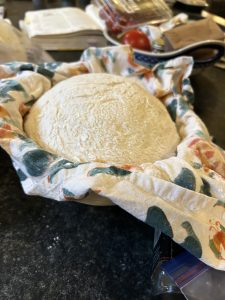
- Prepare a proofing basket by lining the basket or medium bowl with a clean kitchen towel. Dust evenly with wheat starch. Lightly starch your work area. Empty the dough onto the starched area, and lightly dust the top with more wheat starch. Flip the dough over so the starch side is faced down. Lightly stretch it outward in all directions. Fold the edge closest to you up to the middle and press until it sticks. Gently tug the right side to the middle and repeat with the left side so that it overlaps the right a little. Take the top and fold it over the entire round and flip it over so that the seams are now facing down. Shape both hands into cups and rotate and drag the dough multiple times to smooth out the seams and create a smooth ball. Place seam side up in the prepared proofing basket. Lightly cover with plastic wrap and another clean kitchen towel.
- Allow the dough to rise in a warm spot for four hours until it has almost doubled in size. Place the covered dough in the fridge overnight.
- In the morning, remove the dough from the fridge. Gently flip the basket onto a parchment round that will fit in your dutch oven pot. Carefully place the dough in your pot. Allow it to sit room temperature for 30 minutes to an hour. Heat the oven to 450 degrees.
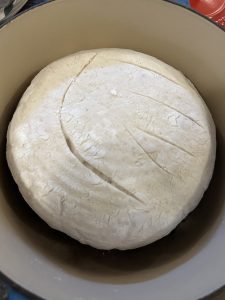
- Score the dough with a razor, lame or super sharp knife, You want the slice to be about half an inch deep. Cover your pot and bake for 45 minutes. Remove the lid, reduce the heat to 425 and bake an additional 45 minutes.
- Remove bread from oven, gently flip onto a wired rack and cool to room temperature. Slice and serve.
Notes
Per serving — Phe: 14 mg | Protein: 0.28 g | Calories: 73 | PKU exchanges: 0.94